| How Pianos Are Moved |

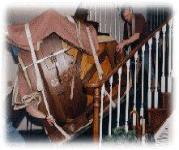
Unless the piano is very small and light, it is
almost always placed on a special skid called a
piano board. The piano is covered with blankets
and strapped to the board. If the piano is to be
moved over a level surface for any distance, the
piano board is put on a dolly - a small platform on
wheels - and rolled to its destination, such as a
truck or stairway. At the stairway, the dolly is
removed and the piano is slid in a very slow and
controlled manner up or down the stairs.
almost always placed on a special skid called a
piano board. The piano is covered with blankets
and strapped to the board. If the piano is to be
moved over a level surface for any distance, the
piano board is put on a dolly - a small platform on
wheels - and rolled to its destination, such as a
truck or stairway. At the stairway, the dolly is
removed and the piano is slid in a very slow and
controlled manner up or down the stairs.
A grand piano is moved on its side, straight side down. First the lid and the pedal lyre
are removed. Then the leg at the straight side of the piano is removed and the piano is
carefully lowered down to the piano board. After the remaining 2 legs are removed, the
piano is covered with blankets and strapped to the board. Stripped down in this
manner, a grand piano is quite thin and will actually fit through a door or other opening
very easily.
are removed. Then the leg at the straight side of the piano is removed and the piano is
carefully lowered down to the piano board. After the remaining 2 legs are removed, the
piano is covered with blankets and strapped to the board. Stripped down in this
manner, a grand piano is quite thin and will actually fit through a door or other opening
very easily.
| Hoisting: Using a Crane |
| Rigging: Using a Block & Tackle |
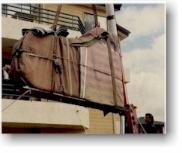
When a piano must be moved to or from a floor other than
the first, many movers prefer to hoist or rig it rather than
move it up or down stairs. Believe it or not, moving a piano
by stairs is actually more dangerous, both to the piano
and to the movers, than hoisting it through an upper-story
window with a crane. Most movers will consent to moving
by stairs when only one flight is involved, or when no other
alternative is possible. Of course, if the building has a
freight elevator that can support the piano, that method is
preferred over all others.
Basically, it is the customer's responsibility to make sure
the piano will fit in its new location. This means not
expecting a piano to be hoisted in a window that's too
small, or carried down a stairway with too low an
overhang, or moved around a corner that's too tight.
Corners are the hardest to judge because they can't be
easily measured. An experienced mover can usually
judge these situations pretty accurately by eye and may
prefer to visit the moving sites prior to moving day if there
is any question about the difficulty of the job. This probably
won't be possible if the move is a long-distance one. If the
piano won't fit in its intended location, the customer will
have to pay for its delivery back to its point of departure, to
an alternate destination, or to storage.
the first, many movers prefer to hoist or rig it rather than
move it up or down stairs. Believe it or not, moving a piano
by stairs is actually more dangerous, both to the piano
and to the movers, than hoisting it through an upper-story
window with a crane. Most movers will consent to moving
by stairs when only one flight is involved, or when no other
alternative is possible. Of course, if the building has a
freight elevator that can support the piano, that method is
preferred over all others.
Basically, it is the customer's responsibility to make sure
the piano will fit in its new location. This means not
expecting a piano to be hoisted in a window that's too
small, or carried down a stairway with too low an
overhang, or moved around a corner that's too tight.
Corners are the hardest to judge because they can't be
easily measured. An experienced mover can usually
judge these situations pretty accurately by eye and may
prefer to visit the moving sites prior to moving day if there
is any question about the difficulty of the job. This probably
won't be possible if the move is a long-distance one. If the
piano won't fit in its intended location, the customer will
have to pay for its delivery back to its point of departure, to
an alternate destination, or to storage.

| This excerpt was taken from The Piano Book, by Larry Fine: The definitive source book on buying & owning a new or used piano |

| © 2000-2021 Concert Pitch Piano Services. All rights reserved. |
| . |
| . |
| . |
| CONCERT PITCH PIANO SERVICES |



| | EXPERIENCED |
| CERTIFIED |
