| Storing a Piano |
The best advice about storing a piano is not to do it if you can help it, or to store it with a friend who will use it
and take good care of it. Storing a piano involves extra moving and an uncertain environment, and certainly
doesn't improve the instrument, to say the least.
Still, there are times when storing a piano is unavoidable, such as when you have to move out of your
house before the movers are scheduled for the long-distance haul (in which case they will pick up and store
your goods for you) or when you arrive in a new city before you've found a permanent place to live.
Most cities and towns have self-storage places where you can rent cubicles of various sizes. When
choosing one, it's preferable that it be at least minimally heated, though an unheated space is by far better
than one that is overheated. Typical cubicle sizes might be 8 x 8 x 6 feet or 5 x 10 x 8 feet. Smaller cubicle
sizes may not have a big enough door. Also be sure that the cubicle you're given is not upstairs and does
not have an overhead entrance requiring a ladder, moveable stairs, or forklift.
Storage In an Unheated Space
Many people keep pianos in summer homes or cottages and wonder how to protect the piano in the winter
when the place is unheated. The conventional wisdom is that pianos should never be allowed to freeze, but
any technician will tell you that pianos left unheated year after year are often in better condition than those in
well-heated houses, the latter usually suffering from the effects of overdryness.
A couple of ways to absorb dampness that often accompanies low temperatures:
- Place some mothballs in the piano (but don't let them touch the finish), close up the piano and leave it as
is, or
- Put some chewing tobacco in a cheesecloth sack and hang it inside the piano
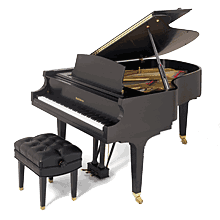
Storing a Grand Piano On Its Side
Storing a grand piano on its side is alright in temporary situations, but not advisable for long periods of
time. It would be best to have a piano tuner remove the action, wrap it in plastic, and put it on a flat surface.
When an action is stored on its side for that long, the weight of the hammers can cause the shanks to warp
toward the bass, messing up the hammer alignment.
and take good care of it. Storing a piano involves extra moving and an uncertain environment, and certainly
doesn't improve the instrument, to say the least.
Still, there are times when storing a piano is unavoidable, such as when you have to move out of your
house before the movers are scheduled for the long-distance haul (in which case they will pick up and store
your goods for you) or when you arrive in a new city before you've found a permanent place to live.
Most cities and towns have self-storage places where you can rent cubicles of various sizes. When
choosing one, it's preferable that it be at least minimally heated, though an unheated space is by far better
than one that is overheated. Typical cubicle sizes might be 8 x 8 x 6 feet or 5 x 10 x 8 feet. Smaller cubicle
sizes may not have a big enough door. Also be sure that the cubicle you're given is not upstairs and does
not have an overhead entrance requiring a ladder, moveable stairs, or forklift.
Storage In an Unheated Space
Many people keep pianos in summer homes or cottages and wonder how to protect the piano in the winter
when the place is unheated. The conventional wisdom is that pianos should never be allowed to freeze, but
any technician will tell you that pianos left unheated year after year are often in better condition than those in
well-heated houses, the latter usually suffering from the effects of overdryness.
A couple of ways to absorb dampness that often accompanies low temperatures:
- Place some mothballs in the piano (but don't let them touch the finish), close up the piano and leave it as
is, or
- Put some chewing tobacco in a cheesecloth sack and hang it inside the piano
Storing a Grand Piano On Its Side
Storing a grand piano on its side is alright in temporary situations, but not advisable for long periods of
time. It would be best to have a piano tuner remove the action, wrap it in plastic, and put it on a flat surface.
When an action is stored on its side for that long, the weight of the hammers can cause the shanks to warp
toward the bass, messing up the hammer alignment.

| © 2000-2021 Concert Pitch Piano Services. All rights reserved. |
| . |
| . |
| . |
| CONCERT PITCH PIANO SERVICES |


| For safe and inexpensive piano storage in Greater Toronto including climate controlled facilities, we recommend Braymore Delivery Co. |
| | EXPERIENCED |
| CERTIFIED |
