Piano of Beethoven's Time
During the eighteenth century, piano builders gradually
extended the keyboard. Two important new developments
were the escapement action for faster repetition of notes
(about 1770 by Stein in Augsburg), and the damper and
soft pedals (1783 by Broadwood in London). Special
pedals were often added to produce exotic effects.
During the eighteenth century, piano builders gradually
extended the keyboard. Two important new developments
were the escapement action for faster repetition of notes
(about 1770 by Stein in Augsburg), and the damper and
soft pedals (1783 by Broadwood in London). Special
pedals were often added to produce exotic effects.
| Evolution of the Piano |
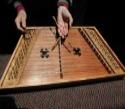

Dulcimer
This ancestor of the piano originated in Iran shortly after the
birth of Christ. It illustrates the basic principles of the piano,
hammers striking multiple strings tuned over a flat
soundboard. Instead of mechanical hammers, dulcimer
players used two light sticks ending with broader blades.
This ancestor of the piano originated in Iran shortly after the
birth of Christ. It illustrates the basic principles of the piano,
hammers striking multiple strings tuned over a flat
soundboard. Instead of mechanical hammers, dulcimer
players used two light sticks ending with broader blades.

Spinet
Though originating in Italy, the spinet was perfected by
English builders in the late seventeen century, about the
time of composer Henry Purcell. The jack mechanism
plucks the strings just as in the virginal, but the wing shape
permits longer strings, increasing the volume and
expanding the range to as much as five octaves.
Though originating in Italy, the spinet was perfected by
English builders in the late seventeen century, about the
time of composer Henry Purcell. The jack mechanism
plucks the strings just as in the virginal, but the wing shape
permits longer strings, increasing the volume and
expanding the range to as much as five octaves.

Virginal
The typical virginal is a small harpsichord with keys at right
angles to a single set of strings. When a key is pressed, a
vertical rod (jack) holding a leather or quill plectrum rises
and plucks the string, producing a louder tone than the
clavichord but without its dynamic variety.
The typical virginal is a small harpsichord with keys at right
angles to a single set of strings. When a key is pressed, a
vertical rod (jack) holding a leather or quill plectrum rises
and plucks the string, producing a louder tone than the
clavichord but without its dynamic variety.

Clavichord
First built around 1400, the clavichord was most popular
three centuries later in the music of Bach. When a key is
pressed, a vertical brass strip (tangent) is lifted toward a
pair of strings. The clavichord has a quiet tone, but the way
it is built allows for some control of dynamics and even
vibrato.
First built around 1400, the clavichord was most popular
three centuries later in the music of Bach. When a key is
pressed, a vertical brass strip (tangent) is lifted toward a
pair of strings. The clavichord has a quiet tone, but the way
it is built allows for some control of dynamics and even
vibrato.


Harpsichord
Pictured as early as the fifteenth century, the harpsichord
form (where the keys are in line with strings) reached its
peak in the period of Bach and Handel. In this shape, the
pattern for the modern grand, the strings are longer,
and the instrument sounds louder than the clavichord.
Pictured as early as the fifteenth century, the harpsichord
form (where the keys are in line with strings) reached its
peak in the period of Bach and Handel. In this shape, the
pattern for the modern grand, the strings are longer,
and the instrument sounds louder than the clavichord.


Cristofori Pianoforte
About 1709, Bartolommeo Cristofori built several
instruments in the harpsichord shape but with hammer
mechanisms surprisingly like the modern piano action.
Because players could control soft and loud (piano-forte),
which was impossible on plucked keyboard instruments,
Cristofori named his new instrument "pianoforte".
About 1709, Bartolommeo Cristofori built several
instruments in the harpsichord shape but with hammer
mechanisms surprisingly like the modern piano action.
Because players could control soft and loud (piano-forte),
which was impossible on plucked keyboard instruments,
Cristofori named his new instrument "pianoforte".
Upright Piano
The upright design was already in use for harpsichords in
the sixteenth century. In the eighteenth century, many
builders (especially in Germany) tried to apply this form to
the pianoforte. In 1800 the first satisfactory uprights were
invented.
The upright design was already in use for harpsichords in
the sixteenth century. In the eighteenth century, many
builders (especially in Germany) tried to apply this form to
the pianoforte. In 1800 the first satisfactory uprights were
invented.
Square Grand Piano
The square piano originated when German builders
(especially Johannes Socher in 1742) tried to adapt
Cristofori's pianoforte to the traditional rectangular shape of
the clavichord. The square piano was popular until about
1900.
The square piano originated when German builders
(especially Johannes Socher in 1742) tried to adapt
Cristofori's pianoforte to the traditional rectangular shape of
the clavichord. The square piano was popular until about
1900.
Piano of the Romantic Era
During the nineteenth century, the piano continued to
become more powerful and responsive. The outstanding
improvements were the double-repetition action of
Sebastien Erard (Paris, 1821) which allowed very rapid
repetition; and the full cast-iron frame of Alphaeus Babcock
(Boston 1825), the basis for today's extended keyboard.
During the nineteenth century, the piano continued to
become more powerful and responsive. The outstanding
improvements were the double-repetition action of
Sebastien Erard (Paris, 1821) which allowed very rapid
repetition; and the full cast-iron frame of Alphaeus Babcock
(Boston 1825), the basis for today's extended keyboard.
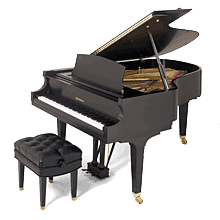
Modern Grand Piano
The grand piano of today incorporates the best qualities of
early keyboard instruments. Cross stringing - a way to
achieve greater richness of tone by passing more strings
over the center of the soundboard - was invented by
Alphaeus Babcock in 1830, but was not used in the grand
piano until the second half of the nineteenth century. The
sostenuto, or middle, pedal was introduced in the late
nineteenth century, permitting greater musical coloring.
The grand piano of today incorporates the best qualities of
early keyboard instruments. Cross stringing - a way to
achieve greater richness of tone by passing more strings
over the center of the soundboard - was invented by
Alphaeus Babcock in 1830, but was not used in the grand
piano until the second half of the nineteenth century. The
sostenuto, or middle, pedal was introduced in the late
nineteenth century, permitting greater musical coloring.

| © 2000-2021 Concert Pitch Piano Services. All rights reserved. |
| . |
| . |
| . |
| CONCERT PITCH PIANO SERVICES |

| . |

| | EXPERIENCED |
| CERTIFIED |
